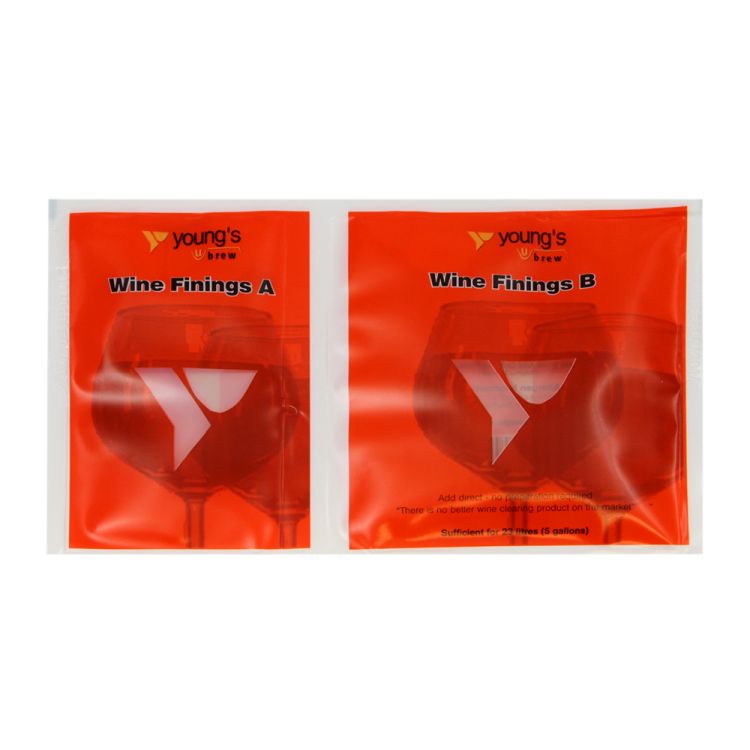
Young's Wine Finings — Two-Part Clearing Agent for 23 Litres
Young's Wine Finings is a two-part (A + B) fining agent designed to clear home made wine quickly and effectively. Most stubborn hazes are caused by colloidal particles — tiny suspended solids that won't settle out on their own. The two-part fining process works by adding component A first (kieselsol), which binds to the particles, followed by component B (chitosan), which causes them to clump together and sink, leaving your wine brilliantly clear.
Suitable for treating up to 23 litres. One of the most effective and widely used clearing agents in home wine making.
How to Use
- Rack your wine off the sediment into a clean vessel
- Add component A and stir gently
- Wait 1 hour, then add component B and stir gently
- Leave for 24–48 hours — your wine should be brilliantly clear
For even better results, pair with Bentonite early in fermentation to remove proteins before fining. Always stabilise with Campden Tablets and Fermentation Stopper before bottling.
Young's Wine Finings
How to Use
Dose
1 twin sachet
A + B, per 23 litres
Used for: Two-part finings (A = silica, B = chitosan) to clear wine quickly.
When: After fermentation has finished and the wine has been stabilised and degassed.
Step by step
1Make sure fermentation has finished and the wine is stabilised.
2Degas - stir hard until no more bubbles appear.
3Add sachet A, stir gently for about 10 seconds and leave for 1 hour.
4Add sachet B and stir gently.
5Leave somewhere cool (about 15°C) for 24-48 hours, then rack or bottle.
Good to know: ALLERGENS: crustacean (chitosan) and sulphites. Not suitable for vegetarians or vegans. Always add A first, then B.
Frequently Asked Questions
How long do wine finings take to work?
Most wines clear within 24–48 hours of adding component B. Very heavy hazes can take a few days — keep the wine somewhere cool and undisturbed while the particles settle. See our guide to how long a wine kit takes.
Why is my wine still cloudy after finings?
The usual culprits are pectin haze (test by mixing a little wine with methylated spirit — if it forms strings or clots, treat with Pectolase) or fining too early while fermentation is still producing CO2, which keeps particles suspended. Make sure fermentation has completely finished before fining.
When should I add finings to wine?
After fermentation has fully finished and you've racked the wine off its sediment. Fining a wine that's still fermenting wastes the finings, as rising CO2 stirs the particles back up.
Are two-part wine finings vegan?
No — component B (chitosan) is typically derived from crustacean shells. For a vegan-friendly approach, use Bentonite (a natural clay) and allow extra settling time.